Latest Research Trends in Arts and Humanities (2026)
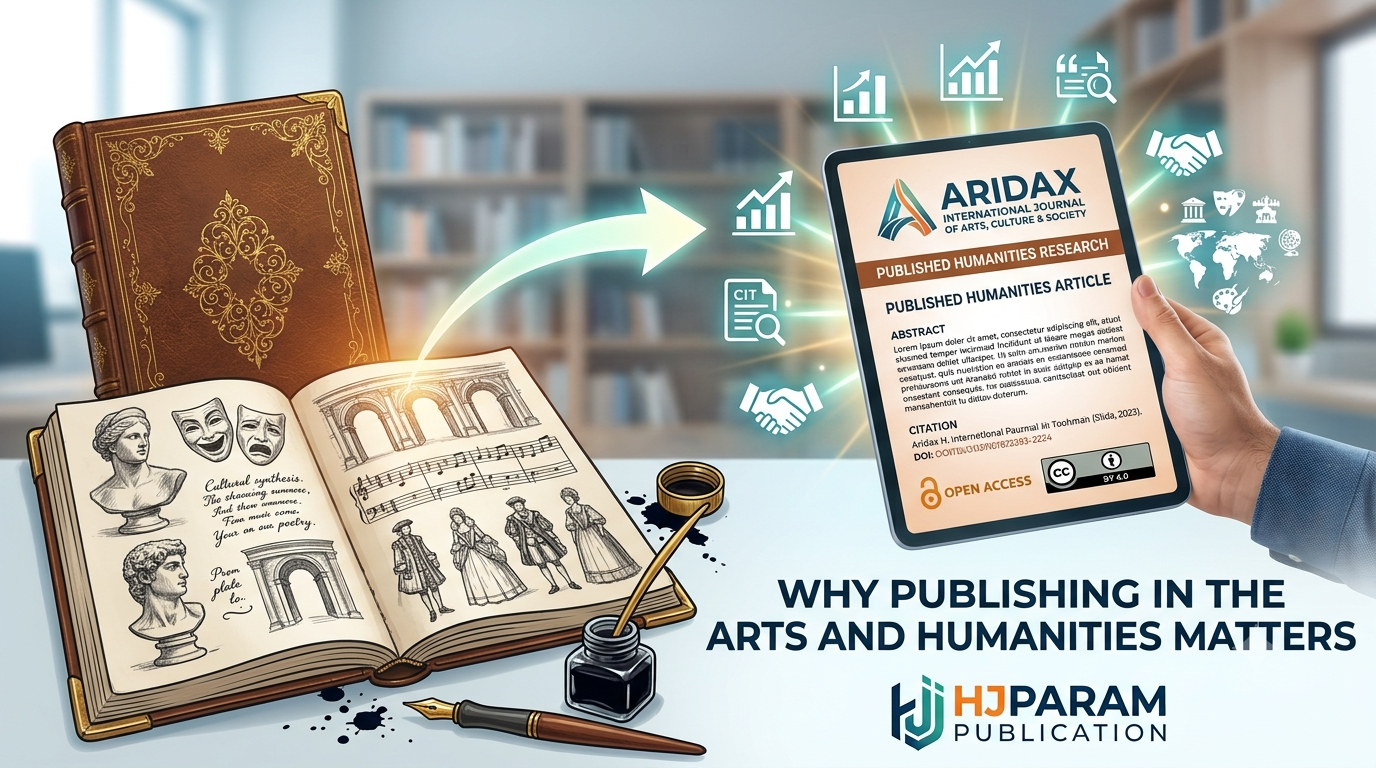
A call-for-papers blog for the Aridax International Journal of Arts, Culture & Society. It covers the journal’s key details: Editor-in-Chief: Dr Ayushi Mishra Double-blind review, with a first decision in 18–24 days Open access under CC BY 4.0 Inaugural issue now open It also lists 15 topic areas, from fine arts to folklore and heritage, and gives the benefits for authors, submission steps and six FAQs. An SEO kit sits at the top.
Latest Research Trends in Arts and Humanities (2026)
The latest research in arts and humanities is being reshaped by artificial intelligence, climate change and a new focus on community knowledge. These shifts are opening some of the most exciting research questions in a generation.
The field is also changing shape. A September 2026 report by the American Academy of Arts and Sciences found that US humanities degrees fell to their lowest level since 1991, yet the humanistic study of the arts, including art history and film studies, grew 18 percent over the past decade (Inside Higher Ed). Arts scholarship is gaining ground, and the topics below show where it is heading.
Trend 1: AI and digital humanities research
Artificial intelligence is the biggest single force in humanities research in 2026. It is both a research tool and a research subject.
- AI as a reading tool. Large language models and vision models now let scholars "distant read" thousands of texts, images and recordings at once. AI agents and multimodal AI were headline themes at the HKADH 2026 conference in Hong Kong.
- AI bias in historical data. A 2026 Digital Humanities Quarterly study warns that AI trained on medieval sources can miss historical hate speech and spread old prejudices at scale. It calls for human-annotated datasets built for historical texts (DHQ 20.3).
- AI in the classroom. The same issue proposes frameworks for using generative AI to simulate premodern events, while keeping students focused on how history is interpreted.
- Humanities as AI's conscience. Philosophers argue that humanistic knowledge, such as ethics and meaning-making, matters more as AI spreads (AI & Society, 2026).
- Funding follows. The US National Endowment for the Humanities runs a Humanities Perspectives on AI grant of up to USD 150,000 for international teams.
- Europe goes multilingual. The EADH 2026 conference in Kraków focused on AI ethics, multilingual infrastructure, open science and cultural diversity.
Trend 2: AI-assisted cultural heritage preservation
Generative AI is now restoring damaged artworks, murals and photographs. A 2026 study describes work on the Dunhuang murals in China and the colourising of historical glass-plate negatives at the National Museum of Korea (Springer, 2026).
The key debate is authenticity. Researchers now build "expert-in-the-loop" systems so that AI does not over-restore or distort an artwork's original style (ShodhKosh, 2026). A recent study of 312 designers found that transparent AI tools make creators feel more ownership of heritage designs (Frontiers in Psychology, 2026).
Trend 3: Environmental humanities
Climate change is not only a scientific problem but a cultural one. Environmental humanities studies how stories, art, history and ethics shape the way people respond to it.
The field brings together ecocriticism, environmental history, eco-linguistics and environmental ethics (NTU Singapore). Universities such as Yale and Oxford now run dedicated programmes, and offshoots like the "blue humanities" study rivers and oceans.
Trend 4: Indian Knowledge Systems and indigenous knowledge
In India, Indian Knowledge Systems (IKS) is one of the fastest-growing research areas, driven by the National Education Policy 2020. The Ministry of Education's IKS Division and UGC invited proposals for IKS Research Centre grants for 2026–27 (report).
IKS research spans Indian music, architecture, sculpture, linguistics, philosophy and literature, which makes it a natural fit for arts and culture scholars. Worldwide, researchers increasingly treat local communities as co-creators of knowledge rather than subjects of study.
Trend 5: Interdisciplinary and public humanities
The defining research opportunities of 2026 lie where disciplines meet. Human-centred AI, climate justice, gender studies, misinformation and open science are all named as leading multidisciplinary directions (Research Horizon). Health humanities, which links literature and ethics with medicine, is also growing.
Research topic ideas in arts and humanities for 2026
Looking for a paper or PhD topic? Each trend opens questions you can study with a local or regional focus.
| Trend | Research topic ideas |
|---|---|
| AI and digital humanities | Can AI translate classical Sanskrit or Urdu poetry without losing its meaning? How do students use generative AI in literature courses? |
| Heritage preservation | Ethics of AI restoration for Indian temple murals; digital archives of endangered folk performance traditions |
| Environmental humanities | Rivers in Hindi and regional literature; climate themes in contemporary Indian cinema |
| Indian Knowledge Systems | Raga theory and music therapy; Vastu principles in modern architecture; oral traditions as historical sources |
| Interdisciplinary humanities | Folk art on social media; misinformation and visual culture; arts-based approaches to mental health |
Publish your arts and humanities research
Arts and humanities research is more relevant than ever. It helps societies understand AI, protect heritage, respond to climate change and value traditional knowledge.
If you are working on any of these trends, consider submitting to the Aridax International Journal of Arts, Culture & Society (AIJACS). It is a double-blind peer-reviewed, open access journal now accepting papers for its inaugural issue.
Submit your manuscriptSources
- Inside Higher Ed: Report: Humanities Majors Disappearing (Sept 2026)
- Digital Humanities Quarterly, 2026
- HKADH 2026 Call for Papers
- AI & Society: LLMs and the increasing role of the humanities
- EADH 2026 Conference call
- Springer: Cultural heritage restoration with image AI
- ShodhKosh: AI-based restoration of digital heritage artworks
- Frontiers in Psychology: Generative AI and cultural heritage design
- NTU Singapore: Environmental Humanities
- IKS Research Centre Grants 2026–27
- Research Horizon: Multidisciplinary research trends 2026
Ayushi Mishra
ContributorScholar and contributor at HJPARAM Publication. Committed to expanding access to high-impact scholarly knowledge and ethical publishing practices globally.