Why Research Article Writing & Publication Matters — and How to Publish with HJParam's Journal
The blog makes the case that research only has value once it’s published, then shows readers how to publish with HJParam. Why publishing matters: it shares knowledge, builds credibility through peer review, advances careers (hiring, promotions, API scores), earns citations, supports funding applications and creates real-world impact. Writing also sharpens the research itself. What makes a strong article: the IMRaD structure (Introduction, Methods, Results and Discussion, plus abstract and conclusion), along with originality, clarity, solid evidence and ethical practice. About HJParam: a Bhopal-based publisher of nine open access Aridax journals, covering science, pharmacy, management, law, psychology, the humanities and Hindi-language research. Articles are published under CC BY 4.0, go through double-blind review by at least two reviewers, are screened for plagiarism and receive DOIs.
Why Research Article Writing & Publication Matters, and How to Publish with HJParam's Journal
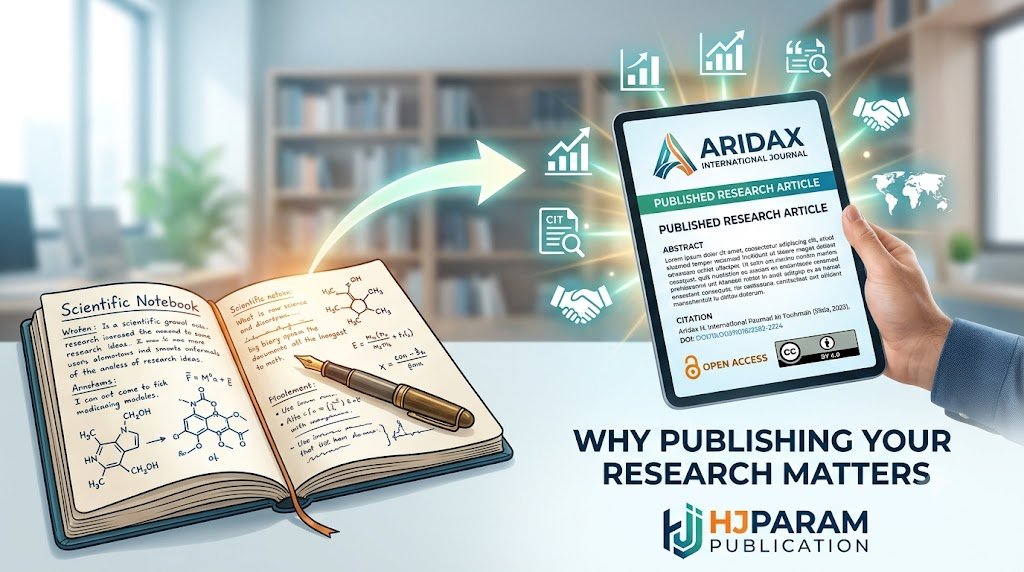
Research that stays in a notebook helps no one. Writing it up and publishing it is what turns months of work into knowledge that others can read, test, cite and build on.
Whether you are a postgraduate student, a faculty member or a working professional, a published research article is one of the most lasting records of your contribution to your field. This blog explains why research writing and publication matter, what makes an article strong, and how you can submit your work to HJParam's Journal.
Why publishing your research matters
Publication is how a finding joins the shared record of science. It brings benefits to the field, to society and to you as a researcher.
- It shares knowledge. A published article lets researchers anywhere learn from your methods and results instead of repeating the same work.
- It builds credibility. Peer review means experts have checked your work. A reviewed article carries more weight than an unpublished report.
- It advances your career. Publications count in PhD admissions, faculty hiring, promotions and API scores for Indian academics.
- It earns citations. Each citation shows your work is useful to others and builds your visibility in indices such as Google Scholar.
- It opens doors to funding. Grant committees look for a record of published, completed work before they fund new projects.
- It creates real-world impact. Policymakers, industry and practitioners rely on published evidence to make decisions.
- It sharpens your thinking. Writing forces you to state your question, method and conclusion clearly, which often improves the research itself.
What makes a strong research article
Most journals expect the IMRaD structure, so editors and readers can find what they need quickly.
| Section | What it answers |
|---|---|
| Title and abstract | What did you study and what did you find, in 250 words or less? |
| Introduction | Why does this question matter, and what gap does it fill? |
| Methods | How exactly did you do it, so others can repeat it? |
| Results | What did you find, shown in clear tables and figures? |
| Discussion | What do the results mean, and what are the limits? |
| Conclusion and references | What is the takeaway, and whose work did you build on? |
Beyond structure, four qualities set good articles apart:
- Originality: a new question, method, dataset or context.
- Clarity: short sentences, defined terms and no padding.
- Evidence: claims backed by data or properly cited sources.
- Ethics: no plagiarism, honest data, credited co-authors, and ethics approval where humans or animals are involved.
About HJParam's journals
HJParam Publication, run by HJPARAM Intellectual Services & Technology in Bhopal, publishes a family of open access, peer-reviewed journals under the Aridax name. They cover subjects from science and engineering to law, commerce, psychology and the humanities.
| Journal | Subject area |
|---|---|
| Aridax International Journal of Science & Technology | Science and technology |
| Aridax International Journal of Research in Science & Technology | Applied science and engineering |
| Aridax International Journal of Life Sciences & Pharmacy | Life sciences, pharmacy |
| Aridax International Journal of Commerce & Management | Commerce, business, management |
| Aridax International Journal of Legal Studies & Society | Law and society |
| Aridax International Journal of Psychology, Behaviour Research and Therapy | Psychology, behavioural science |
| Aridax Journal of Social Sciences & Humanities | Social sciences, humanities |
| Aridax International Journal of Arts Culture & Society | Arts and culture |
| अरीदक्ष शोध संचयन (Aridax Shodh Sanchayan) | Hindi-language research |
What authors get, according to HJParam's published policies:
- Open access: every article is free to read under a CC BY 4.0 licence, and authors keep their copyright (Open Access Policy).
- Double-blind peer review: at least two independent reviewers assess each manuscript, following COPE guidelines (Peer Review Process).
- Plagiarism screening: editors check every submission at the initial screening stage.
- DOIs and archiving: articles get permanent DOIs for long-term access.
- Multidisciplinary scope: one platform for both science and humanities researchers.
How to publish in HJParam's journals, step by step
Submission runs entirely through HJParam's online portal, from registration to final decision.
- Pick the right journal. Match your topic to one of the Aridax journals above and read its aims and scope.
- Download the template. Use the official article template and read the Author Guidelines.
- Prepare your manuscript. HJParam asks for:
- a Word (.docx) or LaTeX file, with figures at 300 DPI or higher
- a title page with all author affiliations
- an abstract of up to 250 words and 5 to 10 keywords
- IMRaD section structure and a data availability statement
- ethics approval (IRB) details where relevant, and a conflict of interest declaration
- Run your own checks. Check plagiarism, references and language before you submit, using the submission checklist.
- Register and submit. Create an account, then upload through Submit Manuscript with the signed copyright form.
- Go through peer review. The editor screens for scope, originality and plagiarism, then sends the paper to two or more reviewers. Reviewers are asked to report within 2 to 3 weeks.
- Revise and respond. If the decision is minor or major revision, fix each point and reply to reviewers point by point.
- Pay the fee and publish. After acceptance, pay the article processing charge listed on the Publication Fees page (USD 1,200 as of this writing, with waivers for authors from low-income countries). Your article then goes live with open access.
Tips for success, and mistakes to avoid
Most rejections come from avoidable problems, not weak research.
| Do | Avoid |
|---|---|
| Write the abstract last, once you know your findings | An abstract that only restates the title |
| Cite recent work, ideally from the last five years | Outdated or self-heavy reference lists |
| Follow the journal template exactly | Ignoring word limits and formatting rules |
| Answer every reviewer comment politely and specifically | Arguing with reviewers or skipping points |
| Ask a colleague to read the draft before submitting | Submitting the first draft |
| Check the journal's indexing in the official database you need (UGC-CARE, Scopus, Web of Science) | Relying on a website badge alone |
| Submit to one journal at a time | Simultaneous submissions, which breach ethics rules |
Start your publication journey
Your research deserves readers. A clear, ethical, well-structured article is how it reaches them, gets cited and shapes your career.
If your work fits one of the Aridax journals, download the template, prepare your manuscript and submit it through HJParam's portal. For questions, write to info@hjparam.com or support@hjparam.com.
Submit your manuscriptSources
Ayushi Mishra
ContributorScholar and contributor at HJPARAM Publication. Committed to expanding access to high-impact scholarly knowledge and ethical publishing practices globally.